A Brief Incursion into Mircea Dinescu’s Poetry
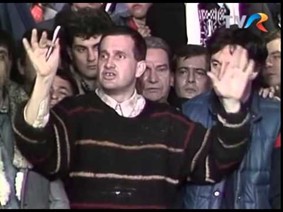
December 1989 The first free televised address to the Romanian people about the end of communism in Romania.
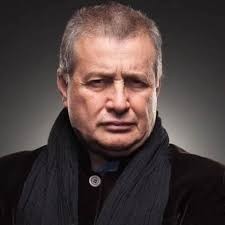
Mircea Dinescu, 2025
In December 1989, there was a moment when the contemporary history of Romania took a magistral turn — the abrupt elimination of the communist ideology through the sudden execution of long-term dictator Ceausescu.
In the history of Romania – one of the two largest countries of Eastern Europe — this moment equaled a dissociation of the Romanian territory and political culture from the immense body of the USSR and a redrawing of the border to virtually add the Romanian territory to the continental “body and soul” of Western Europe (before the country’s actual EU ascension), thus simultaneously reuniting in one breath the country’s past history to its future. In a place where historically, “evil comes from the East”, the brief and bloody Revolution of 1989 was a radical achievement for the Romanians.
Such a major shift had been preceded in the Romanian history by only two similar events: 1) the takeover of its ancient territory (Dacia) by the Roman Empire (106 AD, under Trajanus, through 227AD) and 2) after centuries of co-existing small kingdoms in which – as in other European countries, a mosaic of languages and cultures mingled but lived in separation – the final unification of the three ancient kingdoms (initiated in 1859 under leader A. Cuza, and eventually completed by 1918-1919 with the inclusion of Transylvania and Dobruja) into the current shape of the territorial entity called Romania.
While the 2 older events have always been celebrated in Romanian school books for their civilizational effect, however, the European unification of 1989 has been gradually demoted and viewed spitefully through the lens of recent hazardous politics and the shenanigans of too many ill-advised or ignorant political mass media sources. Much has changed over the past 37 years and, as the cultural mores have sled into corrupt views, that sublime moment that still gives goosebumps to those of us who lived it as youths has come to be filtered through the thicker lenses of skeptical, sarcastic generations who more often than not seem to feel defeated by their own mediocrity or powerlessness and ready to throw the blame on the very founders of the contemporary system.
But in December 1989, my generation was taken aback by the appearance on stage of an electrifying political man, a young poet close to our age and of whom most of us, 18-20 y.o. students at the University of Bucharest had never heard of: Mircea Dinescu, the reader of the first freely-spoken declaration toward the entire people of the country — the long-repressed bewildered people who at that moment were glued to their TVs transfixed by emotions they had never felt over the previous 25 years.
Bold politician, handsome poet and dramatic actor all in one, while not unprecedented in the history of world literatures, is a very rare occurrence. So is a stance that raises itself above the fragmented “left”-“right’-“isms” of its epoques to assert only that oldest human dream of individual freedom, uncompromisingly, along the lines of that famous American landowner-patriot Patrick Henry’s “give me liberty or give me death” position.
We were amazed and we instantly loved him for the frankness that transpared through what looked (and still does) like the most honest, heart-felt, un-rehearsed political address to millions of people, ever.
To the foreign press, Dinescu has remained ‘l’enfant terrible’ of the Romanian revolution; yet, unfortunately, little has been seen of his poetry beyond the national borders over time.
From the backstage of Dinescu’s life, that had included altercations with the communist secret police and persecutions of him as a dissident by the Ceausist-bolshevic regime, his poetry, however, had long preceded his political appearance. It had been saluted from the start by national literary critics for its genuine freshness, perfect cadence, absolutely exhilarating metaphors as well as for the candor and depth of its messages – in one word, for its geniality.
Mircea Dinescu’s work would currently not be easy to describe in few words, on account of its volume and complexity: it spans decades and it delves more deeply than at first sight into topics as diverse as humanist conscience of individual freedom, revolutionary impetus, romantic-sexual love, nature-infused sensuality, desperate loneliness and exhilarating union, humorous satire, phylosophical cues, polemical attacks, patriotic heartache, religious instinctuality, disappointed nihilism, bawdy worldly rhymes, local-flavor folk ballads, aging, metaphysical emotion, and death.
In Romania, an ancestral Thracian zone sheltering a vast (often understated or politically-hushed) history of intermingling ancient bloods – Western, Northern, Levantine, of the Eastern steppes – there is a saying “Every Romanian was born a poet”; yet, in Romanian literature, no one poet aimed his arrows in so many thematical directions and hit his topics with undeniable precision each time; for example, even the top national poet, Eminescu, considered by some critics alternatively as a Romanian Goethe or a national Shakespeare (and whose poetical themes reached out to far off shores, thus conveying universality to his work ) did not live long enough to touch upon the theme of actual physical aging and decay — let alone to mock it with penetrating dark humor that pushes the steps of a Romanian-village ciuleandra dance on the cords of a medieval West-European danse macabre.
I would make the argument that, unlike the works of most other Romanian poets, Dinescu’s poetry should be approached the way one approaches the monologues of an actor. And not any actor, but one who is claiming his passions loudly, starring on the stage of life in a way that has bridged not only political forces but, as it is yet to be recognized, the strong cultural undercurrents of the global literary stages.
This posture is unique in Romanian literature — because, unlike a contemplative Eminescu, a whistling Alecsandri, a heavy-paced Arghezi, a vaporous Blaga, a tongue-in-cheek Toparceanu … and very far from the word-dripping Nichita Stanescu, the coldly-perplexing Barbu and the suave Vasile Voiculescu … this one poet can easily be envisaged straight-on as a swashbuckler Mercutio who, just like the bold Shakespearean character, shouts out his sarcasm toward hypocrisies, whispers his pains, sweats out his passionate desires and sarcastically embraces Queen Mab – both as a pagan goddess and as Death! — with the tip of his sword ready to cut deep into the fabric of his own destiny. Only that this Mercutio issues his own Shakespearean verses and (moodily, it seems at times, such is the easiness of the rolling words) instead of blank verse chooses to apply the difficulty of perfect rhythm and rhyme to them. And if some don’t like his lines, it seems he couldn’t care less either … like the musings of a life-crazed soldier-actor on an invisible front, his art seems concocted to for his own inner passion’s sake even more than it is art for art’s sake.
All the Romanian national authors have been compared by literary critics with great foreign authors: Eminescu with the German Romantics, Arghezi with Baudelaire, Minulescu with the Symbolists, and so on. In literary criticism there is a tendency to apply one poet’s work to another poet’s work and to look for affinities. In this case, what I would dare to attempt is to apply the artistic temperament that connects Dinescu’s work to that of poets and prose/play writers alike – starting, above all and extensively, with Shakespeare’s earthly vigor, emotional virility and nuanced tones as found primarily across the themes of the plays, not in the sonnets (and as found also in the rhyming lines within some plays that divulge the pre-Renaissance or folk poetic core of the Shakespearean artistic temperament).
Such a search for parallelisms with Western classics (necessarily supported with the relevant excerpts of poetry and prose), could then point to the numerous affinities that can be found between the charming, bawdily humorous or dark philosophies of Dinescu’s poems and the tonalities of Chaucer or Boccacio — and, again, that language and moods that the English bard put into the mouths of some unforgettable characters.
As a poet whom some critics compared to Rimbaud (possibly due to the symbolism that both poets embraced), some of Dinescu’s poems would certainly appear to other readers as having much more in common with the sublime naturalness, down-to-earthness, and metaphysical serenity of Villon’s verses.
A Western reader in love with music would certainly sense the surprising pan-Celtic mood and bodhrán-like cadence that seems to connect the Romanian-ballad sound of some of Dinescu’s rhymes to the hearts of Irish, English, and other European ballads (but, perhaps, not so surprising since the Celtic peaceful expansion has once reached as far as the present-day central-Romania lands, no doubt bringing with it lasting ancestral sensibilities that are still running in some local veins today, be that historically acknowledged or not). For instance, while most Romanian folk poems evoke pastoral nature and meek love, Dinescu’s folk-inspired poems have the resonance of warring haiduks’ passions.
And a foreign reader might be interested to learn that Dinescu’s verses that are, after all, rooted in contemporaneity carry the aura of some earlier Romanian bards of “Balkan” (Byzantine-Ottoman-Sephardic) flavor: Neculce, Filimon, Anton Pann, the Vacaresti Brothers who, themselves carry in their poems that copious flavor of the “1001 Nights” sensuous poetry.
Somehow, the postmodern poet who, seemingly, sought to be just himself and nothing more, nowadays comes across as the most representative of pan-European classics whom the Romanian landscape has ever given to its own culture.
At a reader’s leisure, such pan-European cultural connections beg to be established with regard to the inborn artistic temperament from which the output of poetic words has sprung forth – and not with regard to the literary categories poetry/prose or to any abstract positions of inspiration the poet might have followed. This is because in Dinescu’s case, as reputed critics have noted from the beginning, talent came in one piece as a natural gift from the highest spheres and not as a literary skill polished in library rooms; like born-dancers whose dance runs out from within the vibes of their anima to put a different elan vital — “animal vitality” – – into their limbs than ordinary people can summon for themselves, for this poet verses seem to spring from within in an overflowing fountain of emotions — some deep, some fun, some high, some abrupt, some virulent — always reflecting sharply what we see or don’t want to see, always edgy in their warm frankness that ultimately compels us to face the various truths.
A poet who entered head-on into the vortex of history, visibly ready to die on the stage of political conundrums and without even preparing a speech for the momentuous time, and who – in those days – made an entire nation of ordinary people embrace his presence with endearing feelings, would easily bring to the mind of classics readers a link with Romanticism’s Lord Byron, but (especially) with that Elizabethan adventurer-poet, sir Walter Raleigh….
But the “at-large” spirit of some of Dinescu’s poems also remind vaguely of the wild-nature atmosphere of Jack London and the satirical humor of Mark Twain.
On different facets of the same literary kaleidoscope, the desperate virulence or “mad” wittiness of some poems remind us not only the stance of Mercutio but also the jocular temperament of Hamlet…. But then, ask any gum-chewing American youth to give an opinion on some of Dinescu’s socially-engaged rhythms & rhymes, and you might get the shocking response that it sounds a bit like their 21st century generation’s beloved rap-king Eminem (and before any literary critic of cultivated poetry would balk at such a comparison, I should mention that in some valid music analyses the persona and work of Eminem were subtly likened – quite fairly — to Hamlet as well as with the Bard of Avon himself, because of the overall similarities of artistic temperament and acting one’s own work).
It has often been said by Romanian literary critics that, if certain Romanian literary masterpieces had not been “untranslatable” (Caragiale’s, for example) such works would have reached worldwide recognition – a comment often met with skeptical smirks among the more parochial spirits in Romania. But I would expect that any Romanian philologist fully accultured in the West would point to the truth being proverbially in the middle: the reason for a lack of major recognition is not that the translation is lacking. Think that, if so, Lewis Carroll’s tales, for example, would have never made it to universal bibliographies; but they did, with extensive footnotes — the more explanations needed, the more precious the books’ puns. No doubt that narrow politics, lack of investment in promoting Romanian literature overseas, lack of proper translations, and the existing sensitivity of some topics’ base have played an important role in the fact that, to this day, some strikingly wonderful Romanian poems and novels still remain unknown to the Western readers.
A good translation or movie production can either make or break a literary work that is trying to reach outside the limits of its cultural cradle. It seems, then, that the missing link between the most extraordinary Romanian novels and poems and the Western embrace of them is often lost not in the translation of words, but in the grasping by the translators and movie directors of the authors’ poetical spirit (in the case of novels, the intrinsic rhythm-and-rhyme-like emotional tone, “the music” of the written prose)….
For instance, how many local viewers have been left disappointed by the movie productions “inspired by” Mircea Eliade’s Mayitreyi (made on sufficient funds in India and starring a famous British actor) and Eliade’s “Miss Cristina”; or by the movie based on Radu Tudoran’s “The Prodigal Son”. Three works of prose — turned into movies in which the images followed the scripts, but failed to convey the lyrical moods and what could be compared to a soulful blank verse intrinsic to the original texts.
After spending a lifetime visiting Western libraries as an English teacher, I would assert objectively enough that the value of some Romanian books surpass by far that of a plethora of universally-acclaimed foreign volumes. In the field of poetry, many Romanian poets would be highly acclaimed if rightfully presented to foreign readers. Doubtless, among what Romania has to show in terms of contemporary masterpieces, Mircea Dinescu’s poetry should come at the top: any poetry lover stepping into the poetic landscape of our times – not like in forests and palaces as it used to be in classical days, but like in a bazar of the strangest mixtures — after stumbling into the cul-de-sacs of postmodernist blank verses and leaving them in a hurry behind, and upon coming across one of Dinescu’s first volumes would feel as if discovering a treasure box full of ancient and new precious items, some metaphors like charms and keys to pieces of wisdom or to nostalgic smiles or, more often than not, to uncontrollable healthy bouts of laughter; and yet other verses like paths into surrealist paintings in which colors abound — love instincts ride a mammoth-butterfly, and guilty hands are hidden among red poppies in the rye – and the hyperbolas and dichotomies are mesmerizing.
The sensitivity of themes should never be underestimated: for example, the original title of an exceptional poem worshipped by Romanians, written by trans-national poet Eminescu, would instantly raise eyebrows in the Western world, despite the poem’s captivating quality — an always-fresh theme almost two centuries later (note that the “once upon a time, an alien in a galaxy far, far away” sort of line can bring in a different angle of view within the Anglo-American culture that has been worshipping “Star Wars”); and the same masterpiece might be mutely shunned — despite its wonderful translation under the title “Hyperion” by professor Levitchi — for political reasons that are clear to, yet would be less explained by, any adult… In the West, cultural items resonate according to definitions, sensibilities, and areas of comprehension that may differ radically from Romania’s cultural environment in which Romanians feel comfy with what they call Balkan self-indulgence; thus, a poetic gift like “Hyperion” must be offered in proper wrappings of footnotes to ensure it is enjoyed on the same level with Marlowe’s Doctor Faustus.
Dinescu’s themes would not pose the controversy of the Demiurge, although the dilemma freedom – no freedom can be sensed, tortuously, in some poems;his love is of an Adam-and-Eve type, bypassing in whirlwinds of fauvist colors and metaphoric hyperbolas the greyness of daily realities; the leitmotif of (wild?running?old?) horses appears often, not like in medieval fairy tales but more evocative of visions of the steppes; death appears at times with the air of a mistress to the point where the reader can imagine either a hideous hag or a valkirie; and the immensity of nature becomes part of the human body in some poems, imparting not a sense of the poet’s spiritual or philosophical detachment but that of a “larger-than-life” self (to use an American expression usually applied to high-art movie-stars and to self-made personalities); of all, the poems on the theme of aging are disturbingly sad, far from the philosophical posing of classical poets, as if charged with all the other anxieties of the 21st century.
Finding the right words that transpose the atmosphere of the text while simultaneously conveying the artistic temperament from which a unique text – be it poetry or prose – draws its life represents a magic that talented directors accomplish in their movies by means of propping up dramatical instances with music able to penetrate the viewer’s emotional states in order to let images sink deeply during certain scenes (think of what the long-term Italian series La Piovra would have been without Ennio Morricone’s music). It makes sense since from the oldest art days the muse of music was presumed to work in tandem with the muse of poetry. Poets of veritable talent like Dinescu don’t even need the apanage of music– instead they generate the music inside the hearts of the readers by aligning the rhythm and rhyme of the catrens with the heartbeats of the audience – as solitary grassroots poetry was always meant to do.
Last but not least, what should be acknowledged to Dinescu’s poetry is that – while clearly tied with ancestral golden knots to not only the Romanian classics and balladeers but to some of the most impressive classics of the global stage, it all along bears the stamp of the 1960s-1970s postmodernist freedom of spirit – in his case, a spirit that, cloistered in puritanical communist Romania in which our generations grew up, did not suffer from any of the Western psychadelical corruptions of those decades. It is perhaps why his most recent poems, in a Romania-gone-capitalist-astray, seem to deplore the lack of the ”flower-on-guns” medium from which they once drew their miraculous sap; his verses (and prose) are increasingly Pinchon-esque, while his biography has been embracing a phase that somehow manages to combine the savors of a Balkan boyar’s court with the bohemian invites to a variety of artists.
Unlike during the communit times, Romania is now in the position to make its literary talent known on the Western stage to the point where it is not only the names “Ceausescu” and “Nadia Comaneci” that come first to any middle-aged foreigner’s mind during a conversation with a Romanian native (for the younger generations, even those names have faded) – instead, it should be the names of Romanian poets and writers of classical status and contemporary global relevance.
To my generation, and certainly those to come, Mircea Dinescu could be the most relevant contemporary national poet, on account of his biographical makeup that once pushed him into a major political role in the international arena and then pulled him out of it to the safety that accompanies all artists’ freedom of conscience, the ultimate and only independence in which talent can express itself.
In translating some of Mircea Dinescu’s poems into English and posting them on my language & arts humble website, I feel honored to think I made a first little step in the direction of a cultural curtain that still separates Romania from the Western limelight of literary attention — a curtain that should eventually be raised to let Romanian valuable works of poetry and prose shine to the forefront among the best that Europe can boast with in this day and age.
by Gabriela Anderson, 2026
Anglais et Langues Latines